|
November 2, 2022
130 Law Building
4:00pm-6:00pm
|
Fall 2022
Philippe Van Parijs
Professor, Université Catholique de Louvain
Topic: Does Justice Really Justify an Unconditional Basic Income?
Commentators: Sarah Song and Juliana Bidadanure
|
|
March 16, 2022
132 Law Building
4:00pm-6:00pm
|
Spring 2022
Susan Wolf
Edna J. Koury Distinguished Professor, University of North Carolina at Chapel Hill
Topic: Criticizing Blame
Commentators: Hannah Tierney and Holly Smith
PHOTO GALLERY
|
February 13, 2020
Warren Room
295 Simon Hall
4:00pm-6:00pm |
Spring 2020
Antony Duff
Professor of Law, University of Minnesota
Emeritus Professor of Philosophy, University of Stirling
Topic: ‘De Minimis’ and the Structure of the Criminal Trial
Commentators: Christopher Kutz and Andrea Roth
PHOTO GALLERY
|
|
March 7, 2019
Moot Court Room
Law School–Room 140
4:00pm-6:00pm
|
Spring 2019
Tommie Shelby
Caldwell Titcomb Professor of African and African-American Studies and of Philosophy
Harvard University, Philosophy Department
Topic: The Uses and Abuses of Incarceration: Dehumanization, Slavery, and Profit
Commentators:Loic Wacquant and Osagie K. Obasogie
|
April 26, 2018
Warren Room
295 Simon Hall
4:00pm-6:00pm |
Spring 2018
David Sklansky
Stanley Morrison Professor of Law
Co-Director, Stanford Criminal Justice Center
Stanford Law School
Topic: “The Jurisprudence of Blood: How Law Thinks About Violence.”
Commentators: Saira Mohamed and Jonathan Simon
|
April 27, 2017
Warren Room
295 Simon Hall
4:00pm-6:00pm |
Spring 2017
Joshua Cohen
UC Berkeley Law, Philosophy, Political Science
Topic: “Central Park: A Design for Democracy”
|
| March 15, 2016 |
Spring 2016
Samuel Scheffler
New York University Department of Philosophy
Topic: “Membership and Political Obligation”
Commentators: Christopher L. Kutz (BerkeleyLaw) and Kinch Hoekstra (BerkeleyLaw and Political Science)
|
October 27, 2014
Goldberg Room,
297 Simon Hall
4:00 pm – 6:00 pm |
Fall 2014
T.M. Scanlon
Harvard University Department of Philosophy
Topic: “Equality of Opportunity: A Normative Anatomy”
Commentators: Niko Kolodny (UC Berkeley Philosophy) and Manuel Vargas (University of San Francisco Philosophy) |
| October 15, 2013 |
Fall 2013
Don Herzog
University of Michigan Law School
Topic: “Defaming the Dead”
Commentators: R. Jay Wallace (UC Berkeley Philosophy) and Eric Rakowski
(BerkeleyLaw)
PHOTO GALLERY
|
|
February 21, 2013
4:00 pm – 6:00 pm
Room 132 Law Building School of Law
|
Spring 2013
Elizabeth S. Anderson
University of Michigan Department of Philosophy
Topic: “The Social Epistemology of Morality: Learning from the Forgotten History of the Abolition of Slavery”
Commentators: David Copp (UC Davis Philosophy) and Thomas Laqueur (UC Berkeley History)
PHOTO GALLERY |
|
March 22, 2012
|
Spring 2012
Leslie Green
University of Oxford Law
Topic: “Constituting the People” Abstract
Commentators: Niko Kolodny (UC Berkeley Philosophy) and Sarah Song (BerkeleyLaw)
PHOTO GALLERY
|
| March 15, 2011 |
Jules Coleman
Yale Law School
Topic: “The Architecture of Jurisprudence”Commentators:
Talha Syed (Berkeley Law) and
John Ferejohn (NYU School of Law)
PHOTO GALLERY |
|
February 23, 2010
|
Liam Murphy
New York University School of Law
Topic: “What is Law? And Why does it matter?”
Commentators: Thomas C. Grey (Stanford Law School) and Christopher L. Kutz (Berkeley Law)
PHOTO GALLERY |
| April 16, 2009 |
Nicola Lacey
London School of Economics and Political Science
Topic: “Psychologising Jekyll, Demonising Hyde: The Strange Case of Criminal Responsibility”
Commentators: Erin Murphy (Berkeley Law) and David Lieberman (Berkeley Law)
PHOTO GALLERY |
|
October 25, 2007
|
Robert Post
Yale Law School
Topic: “Roe Rage: Democratic Constitutionalism and Backlash”
Commentators:Vikram Amar (UC Davis) and Goodwin Liu (Berkeley Law)
PHOTO GALLERY
|
|
September 19 , 2006
|
Cass Sunstein
The University of Chicago Law School
“Traditions: Constitutional Law and the Authority of the Past “
Commentators: Larry D. Kramer (Stanford) and Philip Frickey (Berkeley Law)
PHOTO GALLERY
|
|
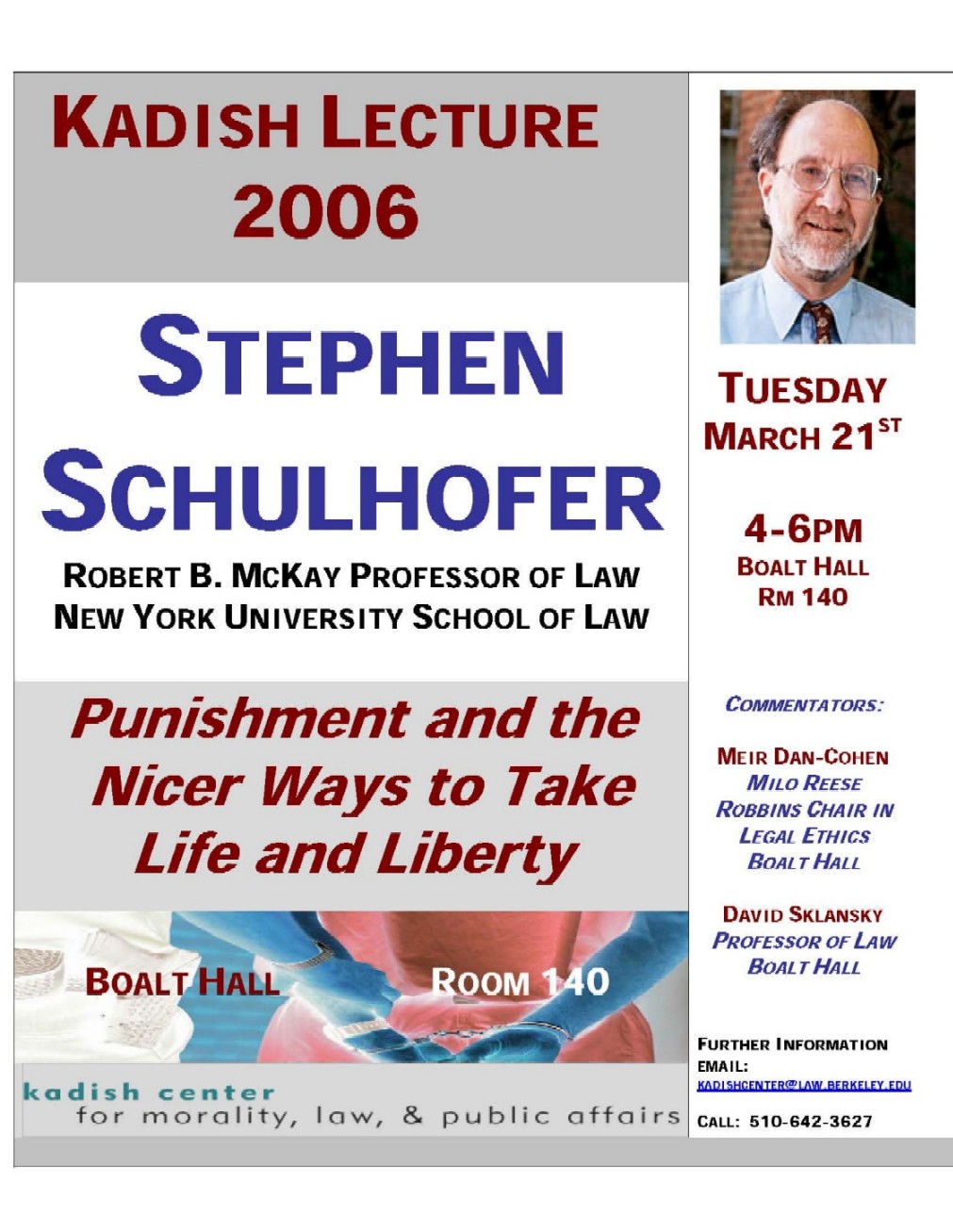
March 21, 2006
|
Stephen J. Schulhofer
New York University School of Law
“Punishment and the Nicer Ways to Take Life and Liberty”
Commentators: Meir Dan-Cohen (Berkeley Law) and David Sklansky (Berkeley Law)
PHOTO GALLERY
|
|
April 13, 2005
|
Seana Shiffrin
UCLA Department of Philosophy and School of Law
“The Divergence of Promise and Contract”
Commentators: Melvin Eisenberg (Berkeley Lawall), James Gordley (Berkeley Law)
PHOTO GALLERY
|
|
April 7, 2004
|
John Gardner
University College, University of Oxford
“Complicity and Causality”
Commentators: Scott Shapiro (Cardozo Law School), Jonathan Simon (Berkeley Law)
PHOTO GALLERY
|
|
Nov. 26, 2002
|
Ronald Dworkin
New York University School of Law
“Law, Interpretation and the Point of Political Philosophy”
Commentators: John Searle (UCB), Eric Rakowski (Berkeley Law)
PHOTO GALLERY
|
|
Feb. 13, 2002
|
Martha Nussbaum
University of Chicago Law School
“Shame, Stigma, and Punishment”
Commentators: Christopher Kutz (Berkeley Law), Seana Shiffrin (UCLA)
PHOTO GALLERY
|
|
Feb. 23, 2001
|
Jeremy Waldon
New York University School of Law
“Actions and Accommodations”
Commentators: Robert Post, Samuel Scheffler (Berkeley Law)
PHOTO GALLERY
|
|
|
Kathleen Sullivan
Stanford Law School
“Election 2000: Epilogue”
Commentators: Jesse Choper (Berkeley Law), Nelson Polsby (UCB)
PHOTO GALLERY
|