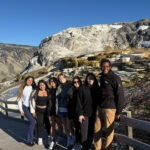
“This cohort has demonstrated why they will be fantastic litigators in the future,” says Judge Mario M. Choi, a former complex commercial litigator who teaches the course.
Sophia Wang, Toni Mendicino, and Amina Kirby are recognized for leading immigration rights advocacy, amplifying Berkeley Law’s international law work, and advancing technical innovations in the school’s classrooms and event spaces.
The changing climate’s growing impact is acting as a powerful threat multiplier — exacerbating violence, exclusion, discrimination, and weak state protection and spurring migration from El Salvador, Guatemala, Honduras, and Nicaragua.
Faculty, students, staff, and alumni call Chemerinsky uniquely positioned to lead Berkeley Law’s role in protecting the rule of law, chart an ambitious course for its future, and solidify its long-term financial footing.
Housers at Berkeley and the California Housing Initiative strive to achieve more affordable housing opportunities across the state and help train a new generation of advocates.
The Spring 2026 Transcript also features a photo essay sharing the motivations of student and alumni pro bono leaders, a 2L’s push to preserve the stories of military veterans, and much more.
Combining a full-time field work placement with a weekly seminar, the immersive semester-long program illuminates how federal statutes, regulations, and policies are made, interpreted, and applied in the nation’s capital.
As industry defendants increasingly push state judges to adopt strict standing limits modeled on federal standards, the center’s Open Door Project is helping Californians keep their access to the state’s courts.
The gift establishes the Zieff-Leitner Public Interest Fellowship, which will allow a graduating 3L student to spend their first year in practice with a nonprofit organization — at a starting salary of $80,000, significantly more than existing fellowships.
Human Rights Clinic Director Roxanna Altholz ’99 relied on support from the law school as she and two other international law experts probed the 2016 murder of the Honduran environmental activist.
Stephanie Alvarez, Evelyn Correa, Rosie Rios, and Alejandro Castañeda Zúñiga worked with migrant-focused groups through the program, which earns students academic credit for doing supervised legal work at a nonprofit or government agency.
His nonprofit Preserving the Stories — which began as a middle school project — has conducted over 200 interviews with former military members to document their memories and insights.
An intuitive problem solver, the senior counsel provides practical and solution-oriented legal advice to the company’s business teams and executives on a wide range of issues.
The New Orleans gathering brought laurels for Field Placement Program Director Sue Schechter, Clinical Professor and Environmental Law Clinic Director Claudia Polsky ’96, Instructional & Educational Technology Librarian Kristie Chamorro, 3L Virginia Frausto-Elizarraraz, and the late Professor Philip Frickey.
An accomplished performer who has toured worldwide, Browne serves as UC Berkeley’s interim carillonist — playing regular recitals, managing, and teaching in the Campanile studio while pursuing an international law career.
Across the legal landscape, the school’s commitment to excellence, community, public mission, and leadership — as well as its entrepreneurial spirit and determined pursuit of justice — was on full display.
The group brings diverse expertise in data science, immigration, and criminal, family, and transactional law, expanding the program’s reach and bolstering its mission to advance racial, economic, and social justice.
Berkeley Law’s 1Ls arrived with a 3.92 median grade point average, 170 median LSAT score, and remarkable diversity — but the numbers tell just a small part of their story.
The content includes featuring our seven new professors, our alumni’s huge impact in the entertainment industry, and new students’ varied motivations for choosing law school — and Berkeley.
While still a law student, Ahern developed an innovative calculation tool that eliminates tedious manual work and fuels faster, more reliable decisions that instill greater confidence.
As a public defender, mentor, educator, and volunteer, this year’s Minnesota State Bar Association Lifetime Achievement Award winner continues to make a significant impact.
Altholz, director of the Human Rights Clinic, is one of three experts appointed by the Inter-American Commission on Human Rights to conduct an independent and impartial investigation of Berta Cáceres’ 2016 assassination.
After 19 years at the school, Schechter — also co-faculty director of the Pro Bono Program — talks about her history at UC Berkeley Law and why she loves what she does more than ever.
Vlacos relishes confronting disability rights and other hot-button issues while working with the Civil Rights and Enforcement Section of the California Department of Justice in San Francisco.
Eager to help develop “workable tools for navigating real-world, cross-border issues,” Kang is getting a close view of hot-button trade issues affecting businesses across myriad industries.
The report from UC Berkeley Law’s student-led Homelessness Service Project analyzes the impact of a crackdown on California’s unhoused population since the U.S. Supreme Court’s Grants Pass v. Johnson decision last summer.
Their wide-ranging work reflects the school’s deep commitment to public service that champions justice, equality, civil rights, transparency, fairness, and accountability.
Charles Weisselberg and his client Veronza Bowers Jr., granted parole last year after spending a half-century in prison, share poignant insights with Weisselberg’s Criminal Justice – Investigations students.
Each spring break, students spread out all over the country — from Alaska to Kentucky — for the UC Berkeley Law Alternative Service Trips program. And each year, students who participate call it one of the best parts of their law school experience.
Now deputy director of the Southern Center for Human Rights and the head of its Impact Litigation Unit, Hollie returns to UC Berkeley Law every year to meet with students.
As an NPR general counsel extern, Chung delves into myriad legal issues to advance free, creative, and safe expression — from antitrust AI to data privacy and intellectual property.
With a bevy of awards and other accolades, Dabbousi has made a meaningful impact throughout the law school — from clinics and advocacy competitions to research centers and student organizations.
After influencing India’s response to deceptive “dark patterns,” Doshi elevates her tech law career arc through prime opportunities for hands-on fellowship and externship experience at UC Berkeley Law.
The former Policy Advocacy Clinic student and supervisor is continuing to make an impact while enrolled in the Jurisprudence & Social Policy Program and will start law school in 2026.
Dormant for several years, the renewed gathering drew clinic leaders from six law schools in the region and addressed myriad topics to empower their mission and maximize their impact.
As the policy director for Long Beach Mayor Rex Richardson, Paul Monge ’18 has a dizzying set of responsibilities managing the implementation of the mayor’s policy and legislative priorities.
From writing amicus curiae briefs to overseeing student projects and organizations to courtroom work, these professors are extending the school’s influence far beyond its walls — and legal academia.
A Bronze Star recipient who served in Afghanistan and later led UC Berkeley Law’s Legal Obstacles Veterans Encounter organization, Lynch relishes advocating for former service members.
A packed pro bono plate and a top role at a journal deliver a law school experience that’s deeply connected to her passion for making systemic change, at the street level and in the academic realm.
Mitchell is one of six UC Berkeley graduate students chosen to join the AI Policy Hub, which aims to shape AI’s future by translating scientific research into governance and policy frameworks.
Two students from UC Berkeley Law’s Death Penalty Clinic fuel an amicus brief highlighting the importance of state constitutional independence and California’s deep record of discrimination in administering capital punishment.
Ball, an East Bay native, will lead the new Social Enterprise Clinic, which begins this fall and will work as outside counsel for local businesses with a social or environmental mission.
From a Supreme Court justice’s visit and an innovative leadership initiative to impactful pro bono work and influential AI guidance, the school’s commitment to excellence, community, and public mission was on full display.
The school recently hosted a launch event for the Preparing for Law School project, which aims to encourage more applicants from underrepresented backgrounds.
Initially planning a public sector career, the Super Lawyer Rising Star says Berkeley’s top business law program sparked her interest in “exploring a different path.”
Coached by alums Patrick Johnson ’19 and James Perry ’11, 3Ls William Clark, Melissa Molloy, and Angela Ma and 2L Rachel Talkington bested 15 teams from law schools around the country.
After a quarter century of pathbreaking international work, the Human Rights Clinic expands its domestic agenda, with Professor Roxanna Altholz ’99 at the helm.
The program has inspired and prepared nearly 800 East Bay public high school students from first-generation and marginalized backgrounds for higher education, fulfilling careers, community engagement, and leadership.