The Center for Law and Work (CLAW) fosters cross-disciplinary scholarship, student engagement, and community involvement to address pressing and emerging labor and employment issues faced by our most vulnerable working populations. With an equity lens, we develop law and policy solutions to what is broken in our current structures of work, in order to chart a promising future of progressive labor policy that is inclusive of all workers and promotes a vibrant and just economy. More about CLAW’s mission.
*NEW* Article by CLAW Faculty Co-Director Professor Catherine Albiston!
“The Hamster Wheel Is on Fire”: How the Pandemic Amplified Inequality in the Academy
by Catherine Albiston, Tonya L. Brito, Cathy Hu, Daniela Campos Ugaz
CLAW's Latest Reports, Notes & Briefs

California Assembly Bill 288: Enabling the State to Protect Labor Rights When the Federal Government Cannot
LAW & POLICY NOTE (September 2025) [updated]
In this Note, Professor Catherine Fisk explains the significance of Assembly Bill (AB) 288, which the California Legislature passed and Governor Newsom signed on September 30, and why the federal National Labor Relations Act does not preempt state labor laws like AB 288 that seek to provide a mechanism to enforce federal labor rights by employees covered by the NLRA. AB 288 provides a mechanism for prompt and effective resolution of disputes over unionization. Under the bill, when the National Labor Relations Board fails to act on an unfair labor practice case for six months or is defunct, workers or businesses can ask the California Public Employee Relations Board to enforce their rights under federal or state labor law. Thus, it enables California to step up to enforce the rights to unionize and to resolve labor disputes when the federal government no longer can or will.Turning the Tables: The Immigration Reform and Control Act & How the Common Law and Non-Employee Status Can Protect Immigrant Entrepreneurs
REPORT (July 2025)
Under the federal Immigration Reform and Control Act (IRCA), businesses that employ workers lacking work authorization (“unauthorized” employees) or fail to comply with the related form “I-9” requirements for employees are subject to potentially substantial civil penalties. No federal court to date has analyzed the precise question under IRCA of what legal standard applies to determine whether an individual who works for a business that the individual also owns and controls—a “worker-owner” as we term it—is an “employee” of the business for whom IRCA’s I-9 requirements are triggered. The answer to this question can be particularly consequential for low-wage workers who have invested what little resources they have into building high-road businesses such as worker cooperatives as a compelling alternative to traditional employment. In this publication, we explain that the answer to this question is decided by the common law and that its application, even while it has resulted in the denial by courts of antidiscrimination protections for workers, can actually help to protect worker-owners and their businesses when it comes to federal immigration law.The DNA of Worker Rights: Key Building Blocks of California’s Model Framework of Wage and Hour Standards
REPORT (January 2025)
With a focus on low-wage workers and California’s modern-day renaissance of wage and hour legislation that began in the second decade of this century, our report identifies the key building blocks (the “DNA”) of California’s wage and hour statutory framework that has advanced the rights of workers, expanded the scope of liability when rights are violated, and instituted critical administrative enforcement mechanisms and tools. Geared towards policymakers and advocates, our report concludes with policy recommendations and model statutes to strengthen current law.Formalism and Functionalism in California’s Unconscionability Doctrine: An Analysis of Fuentes v. Empire Nissan, Inc.
STUDENT SCHOLARSHIP SERIES (July 2024) | By David Beglin, J.D., Berkeley Law, Class of ‘24
In Fuentes v. Empire Nissan, Inc., a case currently pending in the California Supreme Court, the underlying appellate court decision ruled that an employment arbitration agreement was not unconscionable and was enforceable, despite significant abuses in how the contract was formed. Finding a contract unenforceable under the unconscionability doctrine requires a showing of both unconscionability in how a contract was formed (“procedural unconscionability”) and in the terms of the agreement itself (“substantive unconscionability”). Taking a formalistic approach, the Fuentes court views procedural and substantive unconscionability as conceptually distinct inquiries. But California courts must analyze unconscionability on a sliding scale, allowing significant procedural unfairness to compensate for less significant substantive unfairness, and vice versa. This sliding-scale aspect of California’s unconscionability jurisprudence is functional and recognizes that the unconscionability analysis must be holistic. This Note argues that the Court should reject the Fuentes court’s formalism and embrace the sliding-scale approach’s functionalism.Olson v. California: Let the Statute Speak for Itself
LAW & POLICY NOTE (March 2024)
Olson v. California—a case pending before the Ninth Circuit en banc in which plaintiffs Uber and Postmates have alleged that AB 5, California’s worker classification statute that codifies the ABC test, violates their equal protection rights—should be an easy case to resolve against plaintiffs under settled equal protection doctrine. But a panel of the Ninth Circuit found otherwise, in an astounding decision holding that the district court erred in dismissing plaintiffs' equal protection claim. Plaintiffs' claim essentially centers on one provision of the law, California Labor Code § 2777, known as the "referral agency exemption" from the ABC test. They object because they are carved out of this exemption and argue there is no rational basis for doing so. In this Note, we point out a key rationale for the distinctions drawn in the referral agency exemption that is clear on the face of the statute but has not received attention: the exemption’s carve-out, which excludes services provided in certain high hazard industries like the ones in which plaintiffs operate, is rationally related to one of AB 5’s stated purposes, namely, to protect workers when they are injured on the job from the harm of misclassification. This presents a straightforward path for the en banc Court to affirm dismissal of plaintiffs' equal protection claim.


CLAW's Latest Events
The Multiverse of Lawyering: From Community-Based Organizations to Government and Academia, Defining and Shaping Interconnected Worlds of Low-Wage Worker Advocacy | BJELL David E. Feller Memorial Lecture
November 6, 2025
American Agitators Film Screening & Panel Discussion
October 23, 2025
CLAW Fall Kickoff Featuring Guest Speaker Julie Su
September 16, 2025
Understanding the Law & Political Economy of Immigration and Guest Worker Visa Programs | Featuring Daniel Costa, Director of Immigration Law and Policy Research, Economic Policy Institute
October 3, 2024
BJELL Symposium: The Current State and Future of Forced Arbitration
March 21, 2024
Guest Speaker: Marc Pilotin, Region IX Solicitor of Labor, U.S. Department of Labor
February 8, 2024
Colloquium: Contract Theory and Marginalized Workers
October 20, 2023
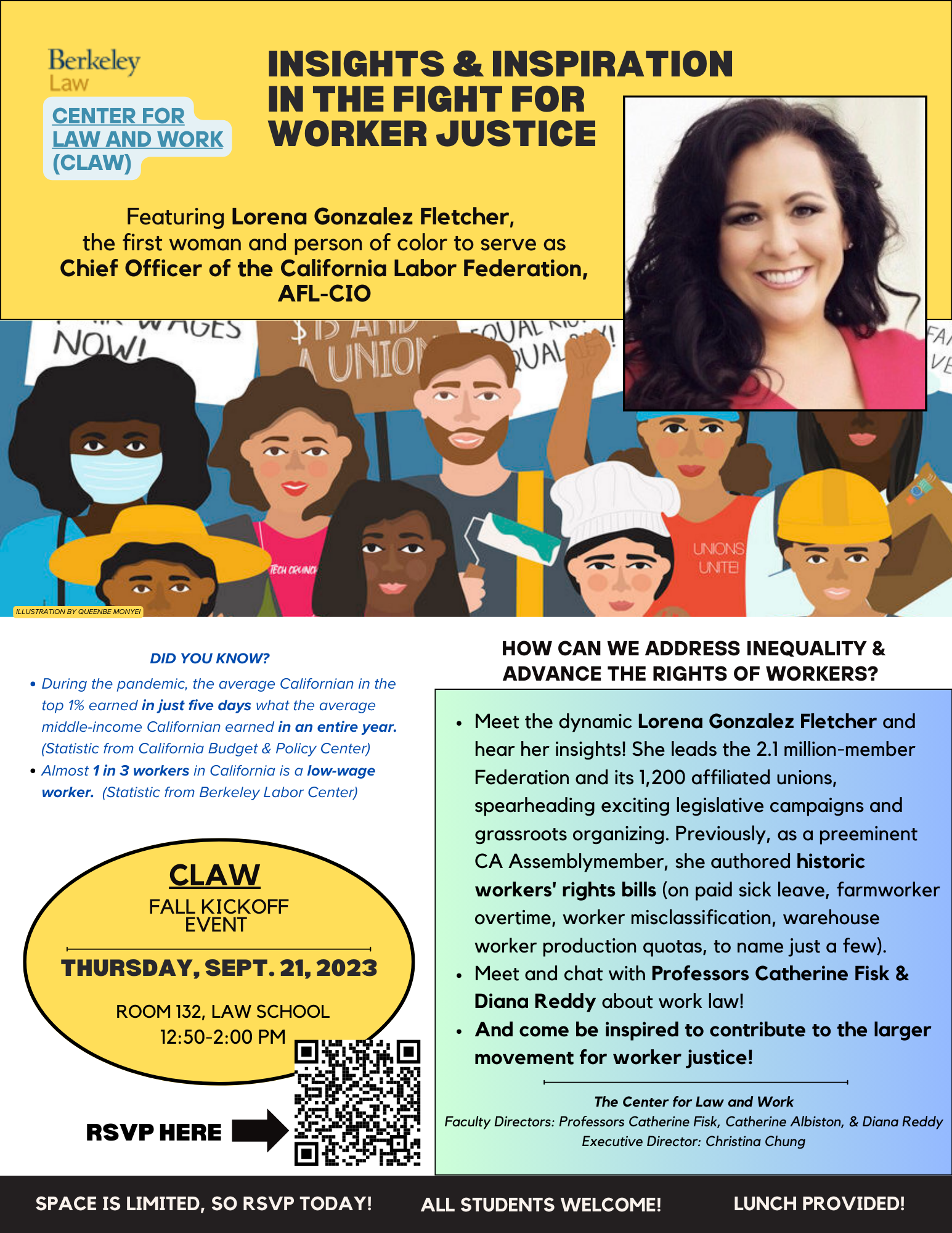
Insights & Inspiration in the Fight for Worker Justice | Featuring Lorena Gonzalez Fletcher
September 21, 2023
Seeding Equity: A New Community-Based Model of Public Investment in Worker Co-ops for Excluded Workers
March 23, 2023