
The application process begins when you visit the Law School Admission Council website, where you must establish an account, register for the Law School Admission Test (LSAT), and submit an application.
The following materials are required for an application to Berkeley Law:
- A bachelor’s degree from an accredited college or university. You may complete undergraduate coursework during the application process. It is not advisable to wait until after your fall grades are posted before you apply if you are a current senior. International students must hold the equivalent of an American bachelor’s degree.
- An LSAT or GRE score taken within the last five years and no later than the January test (including a current writing sample), unless you are eligible to apply with a GMAT score.
- A Credential Assembly Service (CAS) report (i.e., your transcript summary) from LSAC
- Written components of the application, including a personal statement (ideally four, double-spaced pages), a resume (no page limit), optional statements, and any required addenda
- 2-4 letters of recommendation
- A completed online application form. The form is available online via the Law School Admission Council (LSAC). It becomes available each year on September 1.
- $75 non-refundable application fee. The fee cannot be used for processing applications to other law schools within the University of California System.
Continue reading to learn about each component in depth.

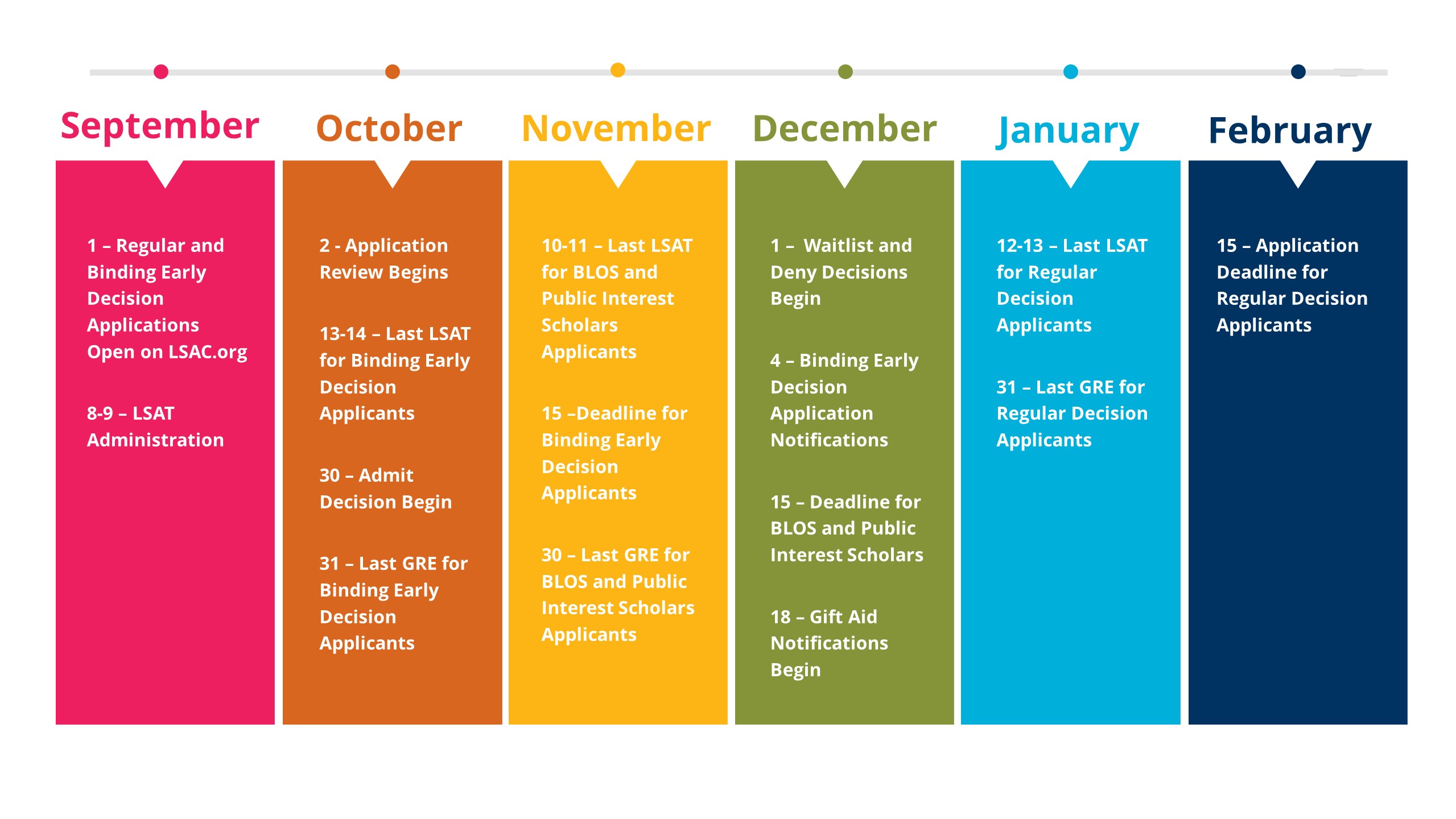
Image Description of Timeline for Applying
Consult this timeline as you prepare your application. Although the application deadline is not until February, consider applying early as we have a rolling admissions process.
This timeline does not include steps you may wish to take in the months leading up to the opening of the application. We highly recommend taking time to prepare for the LSAT, write several drafts of your personal statement, ask your letters of recommendation, and gather all of your required transcripts.

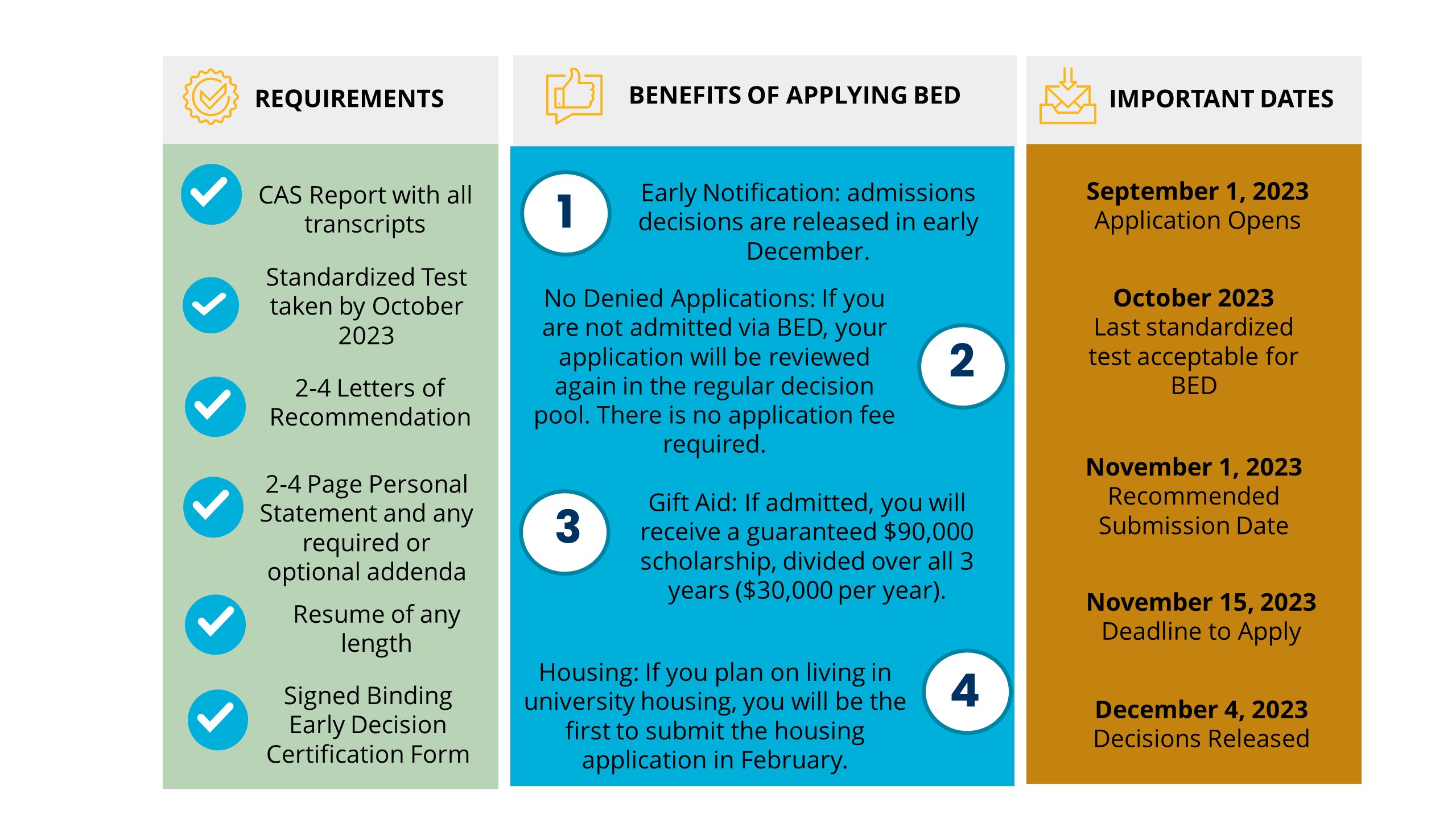
If you have researched your law school options thoroughly and have determined that Berkeley Law is your first choice law school, then you may wish to apply through the binding early decision (BED) application. Click on the graphic below to read about the requirements, benefits, and important dates for the BED application:

Academic Record and The CAS Report
 LSAC operates a service that collects and analyzes data for admission to all ABA-approved law schools, known as the Credential Assembly Service (CAS). Regardless of whether or not an applicant takes the LSAT or another standardized exam, they must create an account with CAS. You must send transcripts to CAS from all of the schools you attended after high school, including community colleges and graduate programs.
It is through CAS that we receive: Your transcripts from all undergraduate institutions attended and graduate programs (including foreign transcripts); transcript analysis; LSAT scores and score report(s); letter(s) of recommendation; and the LSAT Writing Sample. We may also receive as part of your CAS report information that contextualizes your performance prepared by LSAC with data they are provided by applicants. We are not able to receive any of this information in any other way; CAS registration is required and cannot be waived.
You will be able to monitor your CAS status through the LSAC website (LSAC.org). CAS updates (for new scores, new transcripts, new letters, etc.) are sent to us automatically once you send us a first-time report.
What are we looking for in your academic record?
We want to know that you have the ability to succeed academically in law school. When we review your CAS report, we look at your cumulative GPA, but that’s only one factor. We also consider your overall undergraduate academic record. This will include the age of the grades, exceptionally high grades, the difficulty of coursework, time commitments while attending college, grading patterns at the school attended, and grade trends or discrepancies. Graduate work will be considered a “plus factor.” We do not have a GPA cut-off, so all are welcome to apply.

Applicants to the J.D. program are required to take a standardized test for admission. We accept the Law School Admission Test (LSAT) or the Graduate Record Examination (GRE). For a limited group of applicants, mainly those applying for a dual degree, we may accept the Graduate Management Admission Test (GMAT). Please review our GMAT Policy for eligibility criteria.
The LSAT
The LSAT is typically offered eight times each year and can be taken remotely or at examination centers throughout the world. Registration, disability-related accommodation requests, and all other candidate services for the LSAT are managed entirely and led solely by the Law School Admission Council; Berkeley Law has no role in any aspect of the registration process, fee waivers, eligibility, or other determinations.
The LSAT Writing Sample is a requirement to apply to Berkeley Law. It is your responsibility to ensure that you have a valid LSAT Writing Sample available by the application deadline. LSAC requires that you have at least one valid Writing Sample on file in order to issue a CAS report to a school.
LSAT scores are valid for five years. If you took the LSAT between September 2018 and January 2024, then you are not required to take it again (you have a valid and reportable score that we can consider). However, you must ensure that your CAS registration is current so that your test score(s) and transcripts are sent to us.
The GRE and GMAT
For information regarding the GRE or GMAT, please refer to the specific testing agency. In all cases, we require a valid and reportable score in order to review and consider your application. Generally, scores over 5 years old are no longer valid and reportable. It is each applicant’s responsibility to understand when and how a testing agency will report a score and for how long it remains valid. Some will only report a score up to 5 years to the month when the test was administered, for example.
Applicants applying with the GRE or GMAT must also send a CAS report to Berkeley Law. No application will be complete without a CAS report received from LSAC, and the associated CAS fee will not be waived by Berkeley Law.
For the GRE, we will primarily consider your “superscore” when evaluating your candidacy. We do not draw parallels or calculate “comparable” percentiles or raw scores on the LSAT and GRE. Both tests are different and test different things, and scores on one or both will be viewed as distinct from one another.
Applying with Multiple Test Types
If you have a valid and reportable LSAT score it will be seen and it will be considered in our review, even if you wish to be considered with “only” a GRE score. That LSAT score will flow in automatically from LSAC through the CAS report and/or CAS updates. You may write an addendum to provide context for score and performance differences. If you have a valid and reportable GRE score, we require you to send a score report to us (from ETS). Your GRE score(s) will be seen and considered alongside your LSAT score(s), even if you wish to apply with “only” the LSAT. We may consider your application incomplete without any/all applicable test scores.

Personal Statement
You are required to submit a personal statement as part of your application. It should be limited to four double-spaced pages in 11 or 12 point font that is highly legible and with normal page margins.
The thoughts and words contained in your personal statement must be your own and no one else should assist in its creation beyond basic proofreading or critiquing. This must be your original work.
Navigate through the following slides for some tips on writing a personal statement (note that there is no audio):
Resume
In addition to a personal statement we require that you include a resume. There is no page limit, but generally two pages is adequate. The resume should include chronological information about your work experiences, extracurricular activities, honors and awards, volunteer experience, travels, and accomplishments.
Here are some suggestions for creating a law school resume:
- The resume is distinct from a C.V.; however, you are welcome to include information about research or any publications in your resume. URLs may be added, but don’t guarantee that a reviewer will visit those links
- Do not limit yourself to strictly law-related or professional experiences. However, do only add activities from college and beyond (no high school, please)
- You should not assume that the Admissions Committee knows what a particular organization does or what an acronym means, rather, you should explain these briefly or write out the full name
- Do NOT include: a personal photograph, other image(s), graphic(s), or art within your résumé, an objective, a separate list of “Key Qualities” or a “Personal Summary,” motto, or quote
- It is helpful to include the hours and dates you worked or volunteered, as well as your responsibilities – bullet points are perfect!
- For legibility purposes, please do not include multiple colors or fonts in your résumé, and please keep the font no smaller than 10 or 11-points for all text other than your name at the top. We suggest using a highly legible font such as Times New Roman, Arial, Garamond, Calibri, Cambria, etc.

In addition to your personal statement, you may choose to attach a response to one or more of the following questions if you feel the information would be helpful to us when considering your application.
Submission Instructions: In general, optional statements should be attached with the application on LSAC.org, or you can email them to us as a PDF attachment at admissions@law.berkeley.edu if you have already submitted your application. If you are submitting an “Interest in the Legal Profession” statement, please submit your video or written submission via the Kira platform. Additional submission instructions are included below and in the application.

Additional addenda or essays may be required in certain instances (e.g., if you are applying to certain scholarship programs). Required addenda are attached with the application on LSAC.org, or you can email them to us as a PDF attachment at admissions@law.berkeley.edu if you have already submitted your application.

We recommend submitting 2 academic letters of recommendation and one from a non-academic source (work experience, volunteer, etc.). Applicants who have been out of school for a number of years (usually 5+ years) may substitute professional letters of recommendation for academic letters.
You may submit a maximum of 4 letters of recommendation total. In general, we do not complete applications with fewer than two letters of recommendation on file. If you wish for your application to be completed with fewer than two letters of recommendation, please contact us at admissions@law.berkeley.edu to make that request in writing. We will not hold your application for review pending receipt of your recommendations provided that at least two letters are on file. If you want all of your letters to be considered in the review process, be sure that they are available with your Credential Assembly Service (CAS) report when you submit your application.
Letters of recommendation must be submitted through the LSAC Letter of Recommendation Service. Letters sent to us outside of the LSAC Letter of Recommendation Service will NOT be added to your application materials and will NOT be considered when evaluating you for admission. Do not direct recommenders to email us letters or messages regarding your application status, interest, qualifications, etc. Check out this quick video for everything you need to know about letters of recommendation:

A need-based fee waiver program is administered by the Law School Admissions Council (LSAC) that includes waivers of the LSAT registration, Credential Assembly Service (CAS), and other fees. Information and the fee waiver application form is available on the LSAC website. You should act early to obtain a waiver; we will not extend application deadlines based on the timeline for LSAC’s fee waiver review process. If you obtain an LSAC fee waiver, our application fee will be waived automatically when you apply.
Berkeley Law fee waivers are online application-based or may be sent to candidates directly by the school after being identified through the LSAC Candidate Referral Service (CRS). CRS is an LSAC service that is “opt-in,” and questions about that process should be directed to LSAC.
Berkeley Law offers a separate fee waiver program for applicants who participated in a program that is included in one of the three broad categories listed below. If you believe you qualify, submit a Berkeley Law Fee Waiver Request Form (opens on Sept 1) and be sure to attach proof of your participation:
- Honors/Research (e.g., Fulbright, Truman, Rhodes, Marshall)
- Public Service (e.g., Teach for America, AmeriCorps, Peace Corps, current military or veteran)
- Educational/Socio-Economic Disadvantage (e.g., CYDL participant, Gates Scholar, Pell Grant recipient)
Details and a list of qualifying programs are found on the form. If your request does not fall under the categories above, please see the form for further instructions.
Additional Resources
LSAC Need-Based Fee Waiver Application
LSAC Candidate Referral Service (CRS)
Berkeley Law Fee Waiver Request Form (Opens September 1)
The deadline to submit either fee waiver application is 5pm PDT on January 1, 2024. Applicants who do not receive a waiver or who miss the deadline must pay the fee.

Students who wish to examine the law in an interdisciplinary context may arrange to pursue a J.D. degree at Berkeley Law School and a master’s degree in certain other schools or departments within or outside of U.C. Berkeley. Dual degree seekers must apply separately and be admitted to each program. The application and review process are the same for dual degree seekers. For more information and FAQs, see our Concurrent and Combined Degrees Programs page.